
Kenya has spent fifteen years proving that a phone can replace a bank branch. Mobile money settled that argument. The Communications Authority now reports mobile subscriptions above 71 million, and smartphones keep displacing feature phones.
What the phone has not replaced is the plumber.
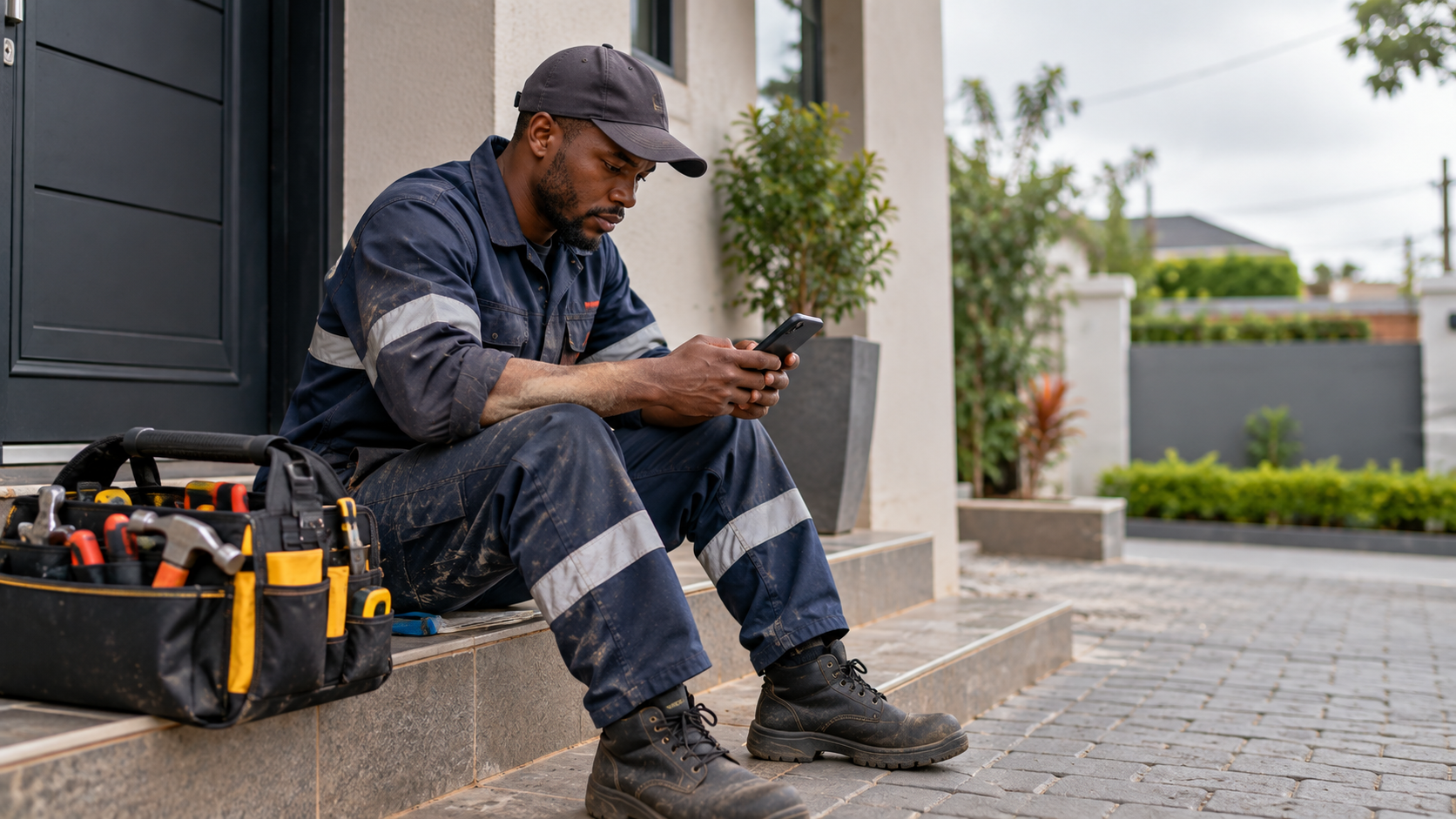
Buying things online works because a product can be photographed, boxed and shipped. A service cannot. Somebody has to come to the house, look at the socket, open the drain, cook the food, walk the dog. The transaction can start on a screen but the work happens in a corridor in Kilimani with a torch.
That gap is the last unfinished part of Kenya's digital economy, and it is bigger than the part already finished.
Both sides are stuck for the same reason
A customer who needs an electrician asks a neighbour, posts in a WhatsApp group, calls three numbers and takes whoever answers. They compare nothing, because there is nothing to compare.
The electrician has the opposite problem and the same cause. He is good at the work. He has no marketing budget, no website, and a reputation that reaches as far as the people who have already hired him. When that circle is quiet, he is quiet.
So you get a market where customers cannot find help and capable people cannot find customers, and both are standing about four metres apart.
All a digital marketplace fixes is the finding.
What a platform owes the people on it
This is the part that gets skipped, usually because it is less fun to write about than technology.
If a platform is asking independent workers to build their livelihood on it, it owes them four answers, and providers should ask for all four before signing anything.
Tell them what it costs. Registration fees, booking fees, commissions, subscriptions. Whatever the model is, it should be written down in a place the provider can find without asking. A platform that is vague about money early will be vague about it later.
Tell them the rules. What gets an account restricted, what happens after a complaint, who decides, and whether there is any way to appeal. A provider whose account can disappear without explanation does not have a business, they have a dependency.
Protect the data. A service platform holds addresses, phone numbers, locations and payment records for both sides. That is a serious amount of information about where people live and who comes to their door.
Build for the phone people actually have. Not the newest one. An app that needs a strong connection and a recent handset excludes a large share of the people it claims to serve, providers most of all.
Kenyan users are not relaxed about any of this. TransUnion's H1 2026 research found 91 percent of Kenyan consumers rank data security as their top consideration before transacting online, against 67 percent globally. The Global Anti-Scam Alliance found 83 percent of surveyed Kenyan adults had been hit by at least one scam in the preceding year.
Those numbers set the bar. A platform that treats trust as a marketing word rather than an obligation will not clear it.
Why the Kenyan version has to be built in Kenya
Payment habits, languages, addresses that are not addresses, informal businesses, the way people already vouch for each other. A marketplace that ignores any of those is building for somewhere else.
Density matters more than coverage. A service app is useless in a city until there are enough providers nearby for a customer to have a real choice, and enough customers for a provider to think the trip is worth it. That is won city by city, which is slow and unglamorous and decides everything.
Where miGuy sits in this
miGuy is a mobile-first marketplace for short physical jobs done at the customer's location. It covers more than 40 categories in Nairobi, Mombasa, Kisumu, Kitengela and Thika. Every category publishes a starting price before anybody books, from 500 shillings for a barber visit to 5,000 for catering.
Listing is free for providers. No registration fee.
That is the whole offer at this stage, and the honest description of it is narrow. It does not make anyone a better electrician. It makes a good electrician findable by people who were never going to hear his name.
The measure that matters
Downloads prove nothing. Neither does a category count.
The numbers that tell you whether something like this works are duller: how many jobs actually get finished, how many customers come back, how reliably providers turn up, and how much of a provider's work eventually comes from the platform rather than their own contacts.
That last one is the real test. If an electrician's month looks different a year from now, the thing worked. If it does not, nothing else on the dashboard matters.